
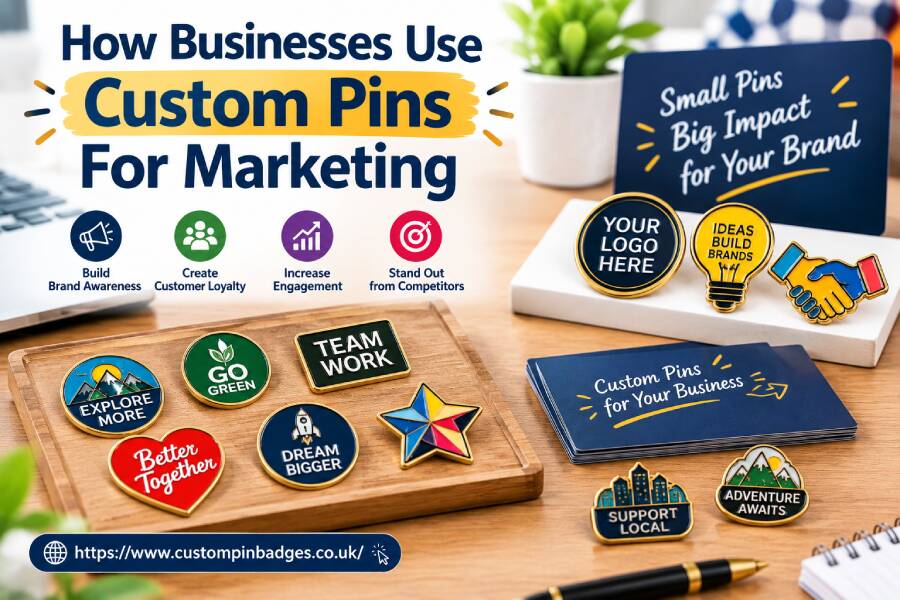
How Businesses Use Custom Pins For Marketing
When a business prefers a small pin, it can travel farther than a billboard. It can sit on a jacket at a conference, appear on a backpack during a commute or become a favourite accessory long after a marketing campaign has ended. That is exactly why businesses are continuously turning to pins as a practical branding tool.
Promotional products are still a substantial marketing channel. The North American promotional-products industry reached a record $27.7 billion in 2025, up 4.2% from 2024. The appeal is easy to understand: a well-designed pin becomes something people can actually keep and use, and not like an advertisement that disappears from a screen. This blog is a business guide to the use of custom pins for marketing.
Why Are Custom Pins Effective For Business Marketing?
Custom enamel pins can work for business marketing because they can combine branding with personal expression. People do not simply see them. They can choose where to display them, which can give repeated exposure to a company without making the promotion feel like an advertisement.
Recent research that is published in 2026 found that 85% of consumers remember the advertiser that gave them a promotional product, while 78% of U.S. consumers are keeping promotional items because they find them useful.
● Turn Customers Into Brand Ambassadors
A customer who is wearing a branded pin is effectively carrying the identity of a company into another environment. For example, one employee wearing a distinctive company pin at a networking event can generate conversations with people who have never encountered the brand before.
The important part is subtlety. A pin will not interrupt someone when they are reading an article or watching a video. It will become part of an outfit, hat, bag or lanyard.
● Make Logos More Memorable
A logo that is printed on paper can be forgotten quickly. A physical object often has a different relationship with memory because the recipient can handle it and decides whether to keep it.
The ASI research of 2026 found that promotional products can generate an average of about 3,300 brand views over their lifetime. Pins can get benefit from the same basic principle when their design is distinctive enough to earn a permanent place on clothing or accessories.
● Create Affordable Brand Touchpoints
Marketing teams often need to balance visibility against budget. Pins are useful here because companies are now ordering them in batches and distributing them at specific moments instead of committing to an expensive mass-media campaign.
This will make them particularly suitable for product launches, employee programs, conferences, customer appreciation campaigns and community events.
● Give People Something Worth Keeping
A forgettable giveaway can become clutter, and a good pin will feel collectable. Design is playing a major role. Elements like strong colours, limited-edition artwork, recognisable symbols, clever slogans and event-specific themes can all increase the likelihood that someone will keep the item instead of discarding it.
● Support Both Online And Offline Marketing
You are not required to operate pins alone. A company may reveal a new pin on social media, photograph customers wearing it, distribute it at an event and then use those photographs in future content.
This can create a useful bridge between physical promotion and digital storytelling. Promotional products are already commonly used alongside social media, internet advertising, email marketing and sales promotions. Brands also make custom pin badges for schools and clubs.
What Are The Steps To Use Pins In A Marketing Campaign?
A successful pin campaign will begin before you send the artwork to production. Businesses need to connect the physical product to a clear marketing purpose.
1. Define The Marketing Goal
You should start with one question: what should the pin accomplish? If the goal is recognition, you need to emphasise the logo. If it is community building, you should prioritise identity and symbolism. If the campaign is designed to encourage social sharing, you must create something visually distinctive enough that recipients will want to photograph it. A clear objective can help prevent the pin from becoming a random giveaway.
2. Identify The Right Audience
The design should reflect the people who are receiving it. A playful illustration may suit a youth-focused brand, and a restrained emblem can work better for a professional association. You should consider age, clothing habits, interests, event setting and the places where recipients are likely to display the item.
3. Create A Recognizable Design
You must keep the central idea easy to understand. Tiny details can disappear when you produce a pin at a small size, so artwork needs strong shapes, readable lettering and appropriate colour contrast. The best designs can often communicate the brand without trying to explain everything.
4. Choose The Appropriate Finish
Material and finish can influence perceived value. You should consider whether the campaign calls for a simple promotional piece, a durable everyday accessory or something that can feel collectable. Also, you should check the attachment mechanism, colour reproduction, dimensions and production quality before you approve a large order.
5. Plan Distribution Carefully
Distribution of the pins can help you determine whether the campaign succeeds. It is easy to hand over pins to everyone who walks past a booth, but targeted distribution can help you create stronger results. You should give one to customers who complete a purchase, employees who reach a milestone, attendees who visit a product demonstration or community members who are participating in an initiative.
6. Measure The Campaign
You should track more than the number of hard enamel pin badges that you have distributed. A business can monitor event engagement, social mentions, email sign-ups, website visits, QR-code scans, repeat purchases or customer feedback associated with the campaign. For a limited-edition series, redemption or repeat-visit data can reveal whether the pins are encouraging continued engagement.
Answer To Common Questions
1. Where should we distribute promotional pins for businesses?
You can distribute your promotional pins in trade shows, product launches, employee events, conferences, retail counters, customer appreciation programs and community activities. Your distribution should match the campaign objective and give a pin to a relevant audience, and it is usually more valuable than handing one randomly to every passerby.
2. What can make a promotional pin memorable?
Recognition and design simplicity are important for promotional pins. A strong symbol, an appealing shape, distinctive colours or a clever reference can make the item easier to remember. Quality also matters the most because people are more likely to keep merchandise that feels attractive and durable.
3. How can I measure pin marketing results for my company?
Measurement of pin marketing depends on the campaign. Businesses can track QR scans, coupon redemptions, event interactions, repeat purchases, website traffic, social mentions, new leads or survey responses. Comparing these figures before and after distribution for longer campaigns can provide a clearer picture of marketing impact.
Final Thoughts
Custom pins can be successful because they can turn branding into something that people can physically own, collect, wear and share. Businesses can use them for recognition, customer loyalty, events, employee engagement and memorable product campaigns. Current promotional-product research shows that useful and appealing merchandise can influence brand perception and purchasing behaviour. The smartest approach is simple: create a pin people genuinely want, give it a clear purpose and connect it to a wider marketing strategy.

I am a dedicated content creator behind CustomPinBadges.co.uk, suggesting effective tips and creative ideas about badge design and branding. I focus on delivering clear, helpful articles that guide businesses, organisations, and individuals through the world of custom pins. My aim is to simplify design choices, production processes, and trend updates of custom pins for readers. Through engaging and informative posts, I strive to inspire confident decisions and successful projects.